






Owner-SideTechnical Partnershipfor Capital Projects
More than a consultant. More than a manager. A committed partner with skin in the game.A technical partner aligned with your outcomes.
Most Development Risk is Not Created on Site
It is created before construction begins, through unclear governance, optimistic assumptions, fragmented design, and misaligned incentives.
What Is the xPM Development Partnership?
A selective, owner-side engagement model where xPM acts as the technical development arm of the owner or investor. We take responsibility for the entire technical lifecycle of a project.
Embedded Leadership
Not advisory distance, embedded technical leadership integrated with your team
Outcome Aligned
Incentives aligned with project outcomes, not billable hours
Risk Ownership
Selective, defined risk sharing where we have control and accountability
Who This Is For
- Developers and owners with significant capital exposure
- Investors seeking greater certainty before committing funds
- Projects with complexity, scale, or elevated risk
- Organizations that value early warning over post-fact explanations
Not Designed For
Commodity or low-complexity projects. This model is reserved for projects where the stakes justify dedicated technical partnership.
Pre-Investment & Due Diligence
Before capital is locked
xPM leads or co-leads:
- Technical, planning, and constructability due diligence
- Cost, schedule, and risk validation
- Feasibility testing and scenario analysis
- Identification of design, scope, and delivery risks
- Capital exposure and contingency logic
Investment decisions made with technical certainty, not optimism.
Design Development & Program Structuring
Before risk is embedded
xPM governs:
- Design development and consultant accountability
- Design-to-budget and design-to-program enforcement
- Constructability and sequencing validation
- Value engineering aligned to investment objectives
- Program structure and delivery strategy
A project that is buildable, fundable, and controllable.
Program & Project Management
Owner-side execution leadership
xPM acts as:
- Owner-side program manager
- Independent technical authority
- Integrator of cost, schedule, risk, contracts, and performance
Including:
- Procurement strategy and contractor selection support
- Construction-phase governance and control
- Claims avoidance and commercial protection
- Executive-level decision intelligence
Early warning, disciplined change, and protected capital.
What Makes This a Partnership
Unlike traditional PM engagements:
- Incentives are aligned with outcomes
- Risk is shared selectively, not transferred blindly
- Engagement spans multiple phases, not isolated tasks
- Governance is designed and enforced, not assumed
xPM succeeds only when the project succeeds.
True Partnership
Aligned Interests, Shared Success
Risk Alignment Philosophy
Risk is shared only where xPM has control and accountability.
All terms are defined transparently and contractually.
Shared Risk Areas
Risk is shared only where xPM has control and accountability.
- Technical feasibility and integration
- Design coordination and constructability
- Program structure and schedule realism
- Cost forecasting and control accuracy
- Risk identification and early-warning effectiveness
Why Owners Choose This Model
- Fewer surprises
- Earlier risk visibility
- Stronger cost and schedule certainty
- Reduced claims and disputes
- A partner who protects capital as if it were their own
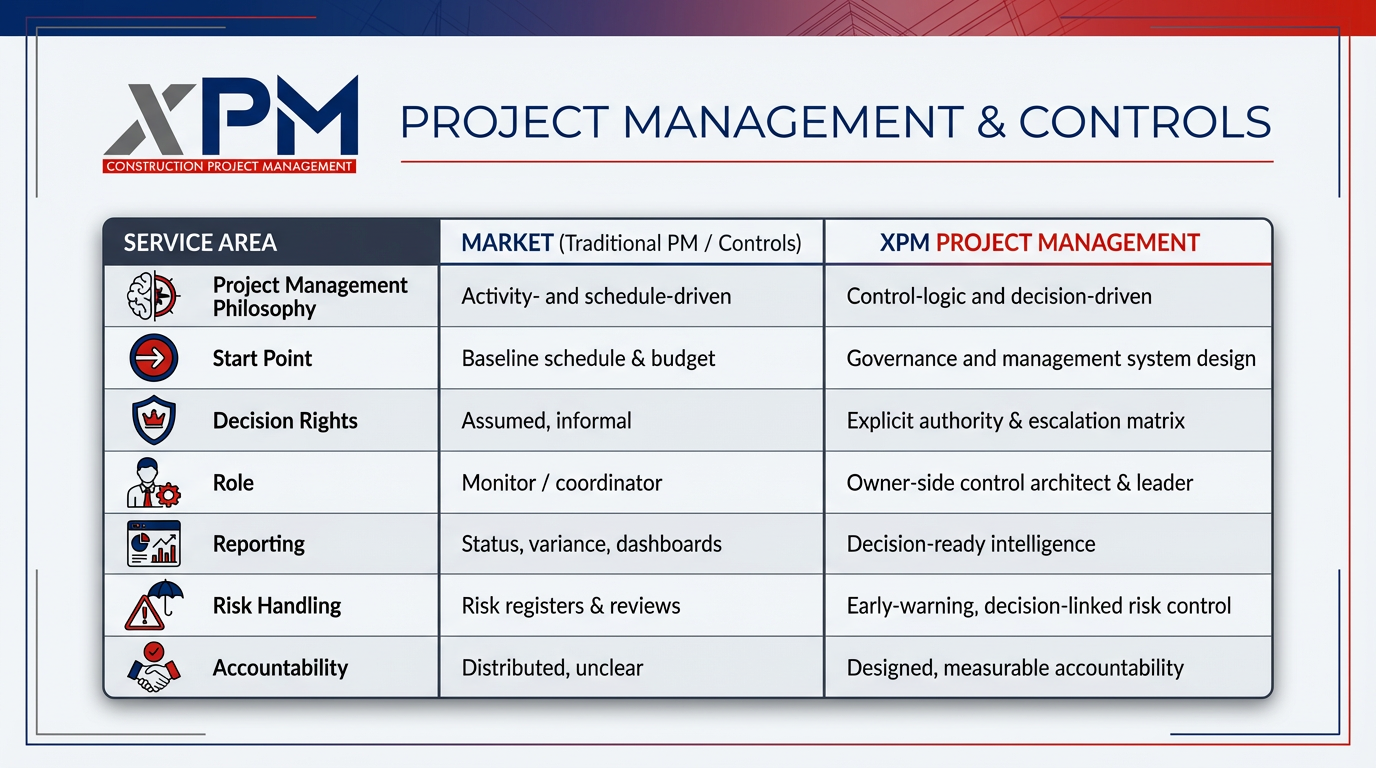
Traditional project controls providers focus on software, dashboards, or staffing. xPM begins earlier, by designing the owner's management and control system, then integrates AI, BI, BIM, and standards into that system. We don't just track projects. We design how decisions, risks, and information are managed across the entire project life cycle.
Market vs xPM
Explore how xPM transforms traditional practices across 10 key service areas
Project Management & Controls
Where xPM Is Clearly Different
Control System Design
before execution. Most firms start with schedules. xPM starts with governance & decision rights.
Owner Outcomes
not activity tracking. Focus on capital protection & risk visibility, not reporting volume.
Integrated Decision System
Cost, schedule, and risk in one system. Managing interdependencies where failures occur.
Prediction Over Visibility
AI for early warning & foresight, not dashboards that explain problems after.
Institutional Knowledge
Data becomes reusable intelligence, not lost at closeout.
Aligned Incentives
Through Development Partnership, we share defined risks & outcomes, not just fees.
The market tracks projects.
xPM designs how projects are controlled, from investment decision to closeout.
Frequently Asked Questions
1What is the xPM Development Partnership?
An owner-side technical partnership where xPM takes responsibility for due diligence, design governance, and program delivery, with aligned incentives and selective risk sharing.
Not consulting at arm's length. Embedded technical leadership.
2How is this different from traditional project management?
Traditional PM tracks execution.
xPM designs the control system first, then governs delivery to protect capital, reduce risk, and preserve decision options.
3When should xPM be engaged?
Ideally before capital commitment, during feasibility, due diligence, or early design.
The earlier the engagement, the greater the impact on cost, risk, and outcomes.
4What risks does xPM share?
Only defined technical and delivery risks where xPM has authority and control, such as design integration, program structure, and forecasting accuracy.
Market and financing risks remain with the owner.
5Does this mean xPM takes equity?
No.
Equity participation is not implied. Partnerships typically use performance-aligned or success-based commercial structures, defined contractually.
6Is this model offered on every project?
No.
The Development Partnership is selective by design, based on project complexity, governance alignment, and mutual commitment to disciplined execution.
For owners who want fewer surprises, and stronger certainty.
A Selective Engagement
The Development Partnership is offered by invitation and suitability only, based on project scale, complexity, governance alignment, and mutual commitment to disciplined execution.
This is not project management as a service.
This is project development as a partnership.