
















AI Is Making Analysis Cheap. Decisions Are Still Expensive.
As AI makes analysis faster, cheaper, and more abundant, the advantage shifts from producing more answers to framing better decisions, with governed evidence, visible assumptions, tested alternatives, and named human accountability.

Summary
AI has made analytical output cheap. It has not made commitment, consequence, or accountability cheap. This is the executive problem the article addresses, and the short version is below.
| Aspect | Summary |
|---|---|
| The argument in one line | AI has made analytical output cheap. In capital projects the scarce resource is no longer analysis. It is a decision someone can defend. |
| What changed | The price of model output collapsed. Querying a model at GPT-3.5 level became more than 280 times cheaper between November 2022 and October 20241, organizational adoption of AI reached 88% in 20252, and 61% of U.S. contractors now use AI or plan to increase investment in it3. |
| What did not change | The measured gains are uneven. AI helps less experienced workers most and can reduce the output quality of the most experienced4. It performs worse than no AI at all on work outside its capability frontier5, and it can slow experienced practitioners who are convinced it is speeding them up6. Cheap output raises the cost of verification, and verification is where consequential decisions are won or lost. |
| Why capital projects feel this first | The constraint was never a shortage of data. Bad data was estimated to cost the global construction industry $1.85 trillion in 202015, and only 11% of owners require data standards from their project teams on all projects16. AI processes fragmented information faster. It does not make the fragmentation go away. |
| What we recommend | Frame the decision before asking for analysis, using seven questions that end in authority. Give evidence five distinct jobs, so that availability is never mistaken for authority. Test the reasoning with a small number of disciplined techniques. Put verification inside the workflow rather than after the answer. Keep a named owner on the commitment. |
| What we do not claim | AI also makes parts of decision support cheaper, including challenge and sensitivity work. Governance carries cost and latency, and can diffuse accountability if it is not proportionate to consequence. Human judgment brings its own optimism bias, and incentives that reward approval over performance will defeat any architecture. |
| What to do next | Take the nine criteria in the xPM Decision Bar to your next gate review, ask which one your current decision case would fail today, and fix that one first. |
Intelligence Is Becoming Abundant. Judgment Is Not.
The cost of producing an answer is falling. The cost of acting on the wrong one is not.
One important part of that shift is now measurable. Adoption has followed. Construction is moving with it.
The price of querying a model at GPT-3.5 level fell more than 280 fold between November 2022 and October 2024, the period covered by the Stanford HAI AI Index.1
Organizational adoption of AI reached 88% in 2025, according to the 2026 edition of the same index.2
of U.S. contractors say their firms use AI or plan to increase investment in it, up from 44% a year earlier, most often for administrative work, estimating, and preconstruction.3
The gains are real, but they are uneven.
5,172 support agents.
A generative AI assistant raised productivity by 15% on average. Less experienced and lower skilled agents improved both the speed and the quality of their work, while the most experienced saw small gains in speed and small declines in quality.4
758 consultants, GPT-4.
Inside the capability frontier of the model, AI users completed 12.2% more tasks, 25.1% faster, at more than 40% higher quality. On a task deliberately placed outside that frontier, they were 19 percentage points less likely to reach a correct solution than colleagues working without AI.5
16 experienced developers.
Working in repositories they knew well, early 2025 AI tools increased task completion time by 19%, even though the developers believed they had been sped up by 20%. The authors caution against generalizing that result beyond their setting.6
Output is becoming cheap. Correctness is not uniform, and the people using AI are not always able to tell the difference. That is the executive problem this article addresses.
The economist Daron Acemoglu makes a related point. Early productivity evidence comes largely from easy to learn tasks, while some of the future effects will come from hard to learn tasks:
“Where there are many context-dependent factors affecting decision-making and no objective outcome measures from which to learn successful performance.”
That is a fair description of most consequential capital project decisions.
So the constraint moves upstream. The harder questions become:
What are we actually deciding? Which evidence deserves weight? What are we assuming? What could change the answer? What consequence are we prepared to accept? And who has the authority to commit?
In our experience, consequential project decisions are rarely improved simply by adding another report. Public evidence points the same way. In an ongoing review of how long decisions take in Northern Ireland’s public sector approval process, officials involved raised one observation often enough for the Strategic Investment Board to record it: “it appears that the more data decision-makers collect, the less comprehensible the problem becomes,” and the report notes no evidence that such additional analysis has led to better decisions.8 Bent Flyvbjerg’s research shows that persistent cost overruns have remained a major project problem across decades.9 We read that as an important warning: better data and methods alone do not guarantee better decisions.
AI does not change that lesson. It raises the stakes, because the volume of plausible analysis can now grow faster than any organization’s capacity to review it.
AI Changed the Economics of Production, Not the Responsibility of Decision
Production efficiency asks how quickly an output can be created. Decision quality asks whether it is grounded, tested, and governed enough to act on.
AI is already helping project teams summarize and review content, identify patterns, generate scenarios, and coordinate multi step work. In a 2024 global survey by the Project Management Institute of 500 project professionals who already use generative AI, across 18 sectors and 12 countries, 53% reported using it to summarize and review content, and 62% of those said it had improved their productivity.10 Deloitte’s 2026 outlook reports that many engineering and construction firms are piloting agentic AI systems “to autonomously manage complex scheduling, coordinate workflows, and mitigate risk,” without quantifying how many.11 A 2022 systematic review of AI in construction, covering literature published before the generative AI wave, identified reducing the time spent on repetitive tasks as the major opportunity.12
Those capabilities are useful. They are not the same as decision quality.
A faster analysis can still use the wrong baseline.
A strong summary can still rely on superseded evidence.
A sophisticated model can still hide a weak assumption.
A precise forecast can still answer the wrong management question.
A confident recommendation can still be wrong, or exceed the authority of the system that produced it. The generative AI risk profile published by the National Institute of Standards and Technology names this directly: “confabulation,” the production of “confidently stated but erroneous or false content.”13
| Production efficiency | Decision quality |
|---|---|
| asks how quickly and economically an output can be created. | asks whether that output is grounded, contextualized, tested, explainable, and governed enough to support a consequential action. |
| Becoming cheaper. | Is not. |
In a capital project, a weak decision does not remain on a screen. It becomes a procurement commitment, a contract position, a schedule consequence, a retained risk, or a change event. The scale of that exposure is visible in dispute data.
The same report notes that 80% of claim values are $25 million or less and almost half are below $5 million, so the average is heavily influenced by a small number of very large claims. It attributes the leading cause to errors and omissions in contract documents rather than to decision quality, so these figures indicate the size of the consequence, not its cause.
The most valuable AI implementation is therefore not the one that generates the most outputs. It is the one that improves the quality and speed of a real management decision without weakening accountability.
In Capital Projects, Cheap Analysis Does Not Equal Good Decisions
The industry does not have a data shortage. It has a decision shortage.
Capital projects already generate large volumes of information across schedules, estimates, commitments, procurement, design, contracts, RFIs, submittals, risk, BIM, field reporting, and change management.
The industry does not have a data shortage. It has a decision shortage.
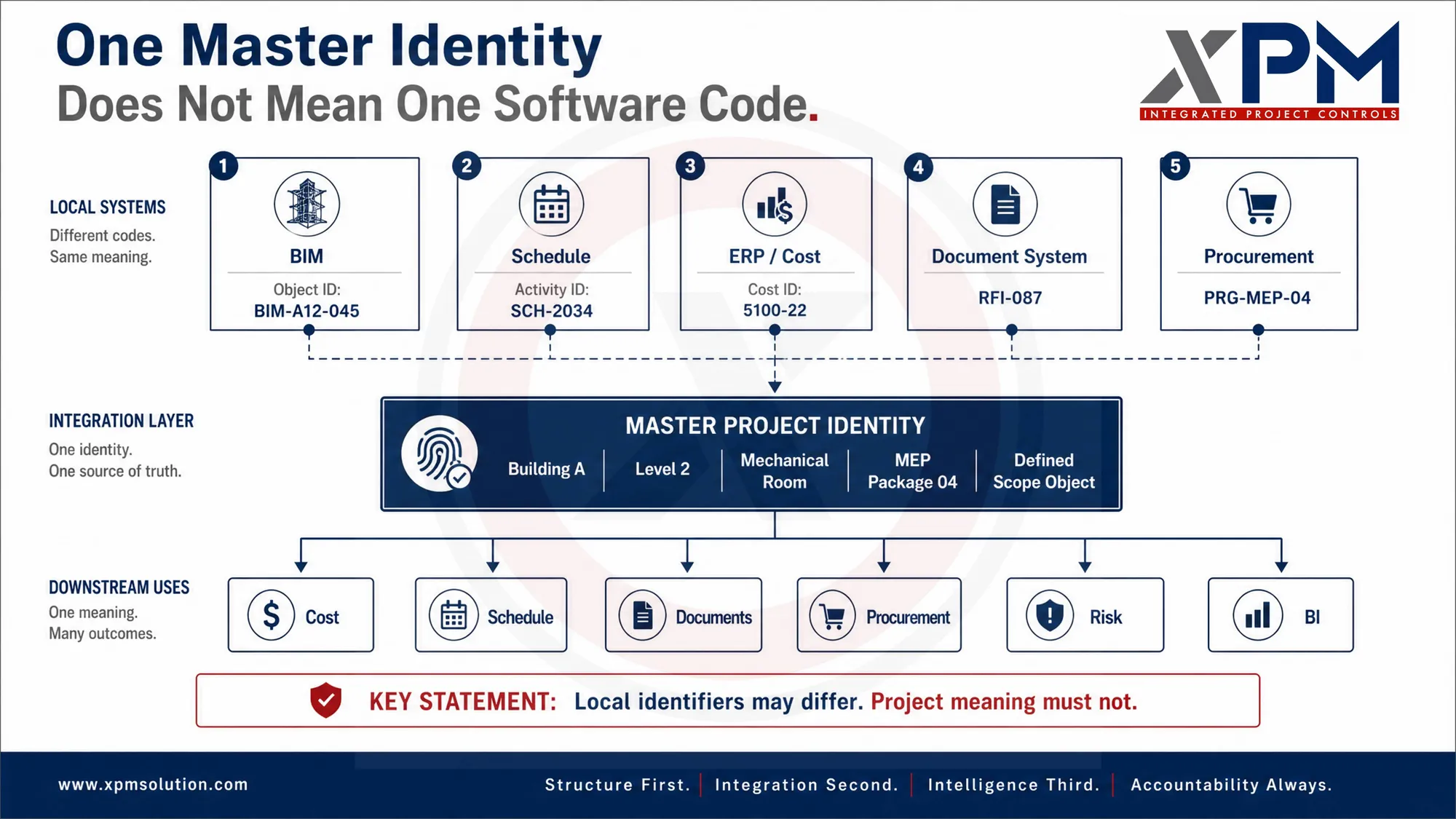
The problem is whether that information carries a consistent meaning. One system identifies work through a cost code, another through an activity ID, another through a location, procurement package, or contract line item. Those systems can be technically connected and still describe different versions of the same project.
One scope of work, described five ways
Technically connected, and still describing different versions of the same project.
Three recent studies point the same way:
the estimated cost of bad data to the global construction industry in 2020, according to Autodesk and FMI.15
of all rework was attributed to decisions based on bad data in the same study, meaning data that is inaccurate, incomplete, inaccessible, inconsistent, or untimely.15
of owners require data standards from their project teams on all projects, in the 2025 Dodge owner study.16
Autodesk and FMI.
They estimated that bad data, meaning data that is inaccurate, incomplete, inaccessible, inconsistent, or untimely, cost the global construction industry $1.85 trillion in 2020, with decisions based on bad data accounting for about 14% of all rework. Thirty percent of respondents said more than half of their project data is bad.15
The 2025 Dodge owner study.
Produced with the National Institute of Building Sciences and supported by Autodesk, Esri, and Trimble, it found that only 11% of owners require data standards from their project teams on all projects, and that 64% invest in technology infrastructure while only 30% invest in a process to manage new technology adoption.16
Deloitte and a 2022 review.
Deloitte notes that poor quality data continues to frequently undermine the reliability of analytics and AI solutions11, and the 2022 review named the fragmented nature of the industry, with its resulting problems of data acquisition and retention, as the biggest challenge to adopting AI on construction sites.12
Two of those three studies are sponsored by technology vendors, which is a reason to read the direction of travel rather than the precision of any single figure.
APIs move data.
Integration preserves meaning.
If scope, quantity, location, responsibility, schedule, cost, procurement, risk, and change are not linked through a governed project structure, AI may process fragmentation faster. It does not make the fragmentation disappear. AI does not automatically improve a weak management process. It can make that process faster, more scalable, and harder to question.
The same principle applies to evidence. A drawing may be current or superseded. A historical case may be comparable or misleading. A benchmark may provide context without establishing a contractual requirement. Information management standards already treat this as a governance issue. ISO 19650-1 uses revision and status codes to identify the permitted use of information containers. The 2018 edition remains the current published edition while a second edition is under development.17
For executives, the practical question is:
What should we trust, for this decision, at this time?
It matters whenever the organization must award or hold, proceed or pause, negotiate or clarify, revise a forecast, change contingency, repackage procurement, escalate an exception, or commit capital.
These are not data questions. They are management decisions informed by data.
The Executive Advantage Is Better Framing
When AI can generate many plausible answers, the quality of the question becomes more valuable.
We would not begin a consequential decision with What does the AI recommend? We would begin with seven questions.
- 01What are we deciding?
- 02Which evidence?
- 03Which context?
- 04Which assumptions?
- 05Which scenarios?
- 06Which consequences?
- 07Whose authority?
The sequence
The sequence moves from information to meaning, from meaning to choice, and from choice to accountability. The executive constraint is rarely the absence of another twenty page report. More often it is one unresolved assumption, one commercial exception, one missing approval, one untested scenario, or one threshold that could reverse the recommendation.
Better framing makes those conditions visible.
Five Management Questions That Organize Decision Support
Project Controls is built around management questions. AI does not replace them. It helps answer them earlier, more continuously, and with broader evidence.
AI does not replace them. It can help answer them earlier, more continuously, and with a broader body of evidence.
- Q1 to Q5
- Q1 to Q5 are the five xPM management questions — what should be the case, what happened, what is happening, what could happen, and what should we do — that organize decision support so that evidence answers a defined management question rather than the other way around.
| Question | What it organizes |
|---|---|
| Q1 | What should be the case?Targets, baselines, constraints, thresholds, and acceptable positions. Before measuring variance, management needs a reference point. |
| Q2 | What happened?The factual and historical record: what changed, was approved, committed, delayed, or paid, and what comparable situations experienced. |
| Q3 | What is happening?Live signals, unresolved exceptions, changing exposure, and assumptions that may be weakening. |
| Q4 | What could happen?Ranges, drivers, scenarios, sensitivities, and reversal conditions. The purpose is not to predict the future perfectly, but to understand how fragile the current position is. |
| Q5 | What should we do?Viable alternatives, trade offs, conditions, recommendations, and monitoring requirements. This is where analysis becomes operational. |
The question comes first. The evidence answers to it, not the other way around.
Not All Evidence Has the Same Job
Once the question is clear, the next problem is evidence architecture. Availability should never be confused with authority.
The current project record, organizational history, standards, professional guidance, and external information can all contribute to a decision. They should not be blended into one undifferentiated pool.
D1 to D5 are five evidence jobs, not a maturity ladder.
- D1 to D5
- D1 to D5 are the five distinct evidence jobs in the xPM framework — frame the decision, prove it from the live project record, remember comparable organizational history, test it against standards and disciplined methods, and challenge it with outside evidence — so that the availability of information is never mistaken for its authority over the decision.
| Code | Job | What it covers |
|---|---|---|
| D1 | Frame | What are we deciding?The decision object, scope, alternatives, timing, gates, ownership, and authority. A poorly framed decision cannot be rescued by more analysis. |
| D2 | Prove | What does this project prove?Governed evidence closest to the live project: contracts, bids, schedules, estimates, quantities, drawings, approvals, and cost and procurement records. The critical questions are provenance, status, applicability, and version.17 |
| D3 | Remember | What happened to us before?Organizational memory: prior projects, recurring patterns, comparable outcomes, supplier performance, and previous commercial decisions. AI can add real value here by making experience easier to retrieve and test. |
| D4 | Test | What should disciplined practice test?Relevant standards, professional guidance, governance frameworks, and structured methods, used to expose what the current reasoning may have missed. The purpose is to challenge the reasoning, not to turn a framework into an automatic answer. |
| D5 | Challenge | Does outside evidence strengthen or challenge what we think we know?Market information, research, public cases, and benchmarks, used as controlled challenge and never as silent authority over the live project. |
Different evidence has different jobs.
From Questions to Evidence to Decision
A structured way of working that makes the path to a commitment explicit. The methods should follow the decision, not the other way around.
The xPM Strategic Decision architecture is a decision method. It is a structured way of working that makes the path to a commitment explicit. It is not an autonomous system, it is not a software product, and it does not produce “the answer.”
The decision path
Four things travel that path, and they are not interchangeable. A fact is what is observed. A forecast is what is expected. A recommendation is what should be considered. A commitment is what the organization decides to do and will be held accountable for. Each can support the next. None of them is the commitment.
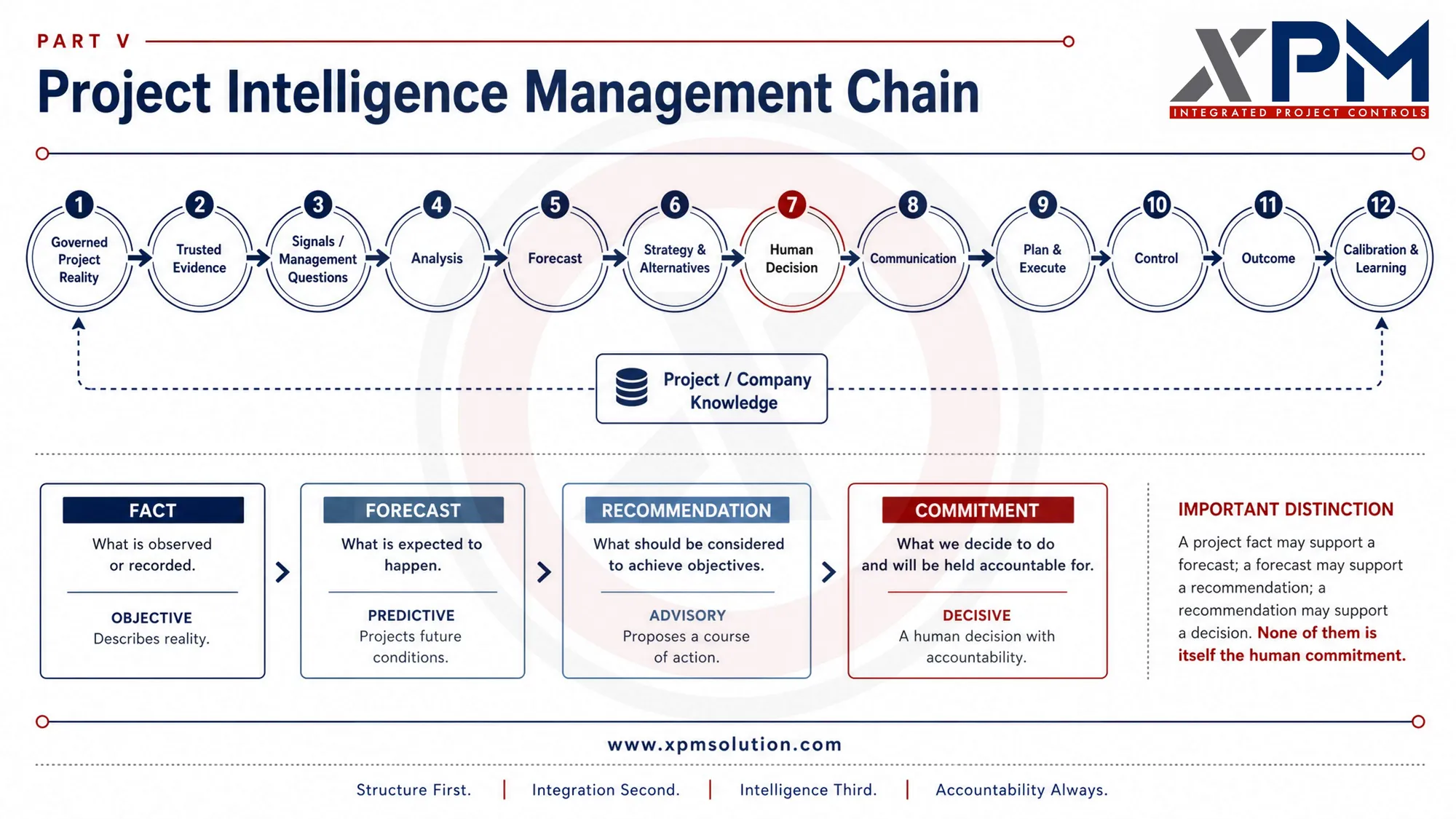
Q1 to Q5 organize the management question. D1 to D5 organize the evidence. The next responsibility is to expose what could change the conclusion: which assumptions are material, which thresholds matter, what evidence is missing, which scenario would reverse the preferred position, and when the decision should be revisited.
A small number of well documented techniques covers most of the need:
Key Assumptions Check
Makes explicit what the analysis takes for granted. It is one of the structured analytic techniques set out in a primer published by the U.S. intelligence community, which presents them as aids to analysis rather than a complete method.18
Reference Class Forecasting
Challenges an inside view estimate with the actual outcomes of comparable projects, in order to counter optimism bias and strategic misrepresentation.19
Pre-Mortem
Asks the team to assume the project has already failed and to explain why, which makes it safer to voice reservations before commitment.20
Sensitivity and Scenario Analysis
Shows which variables actually move the result, and prevents one future from being treated as certain.
Sophistication is never the objective by itself. The objective is a decision case that another qualified professional can understand and challenge.
What AI Should Actually Do
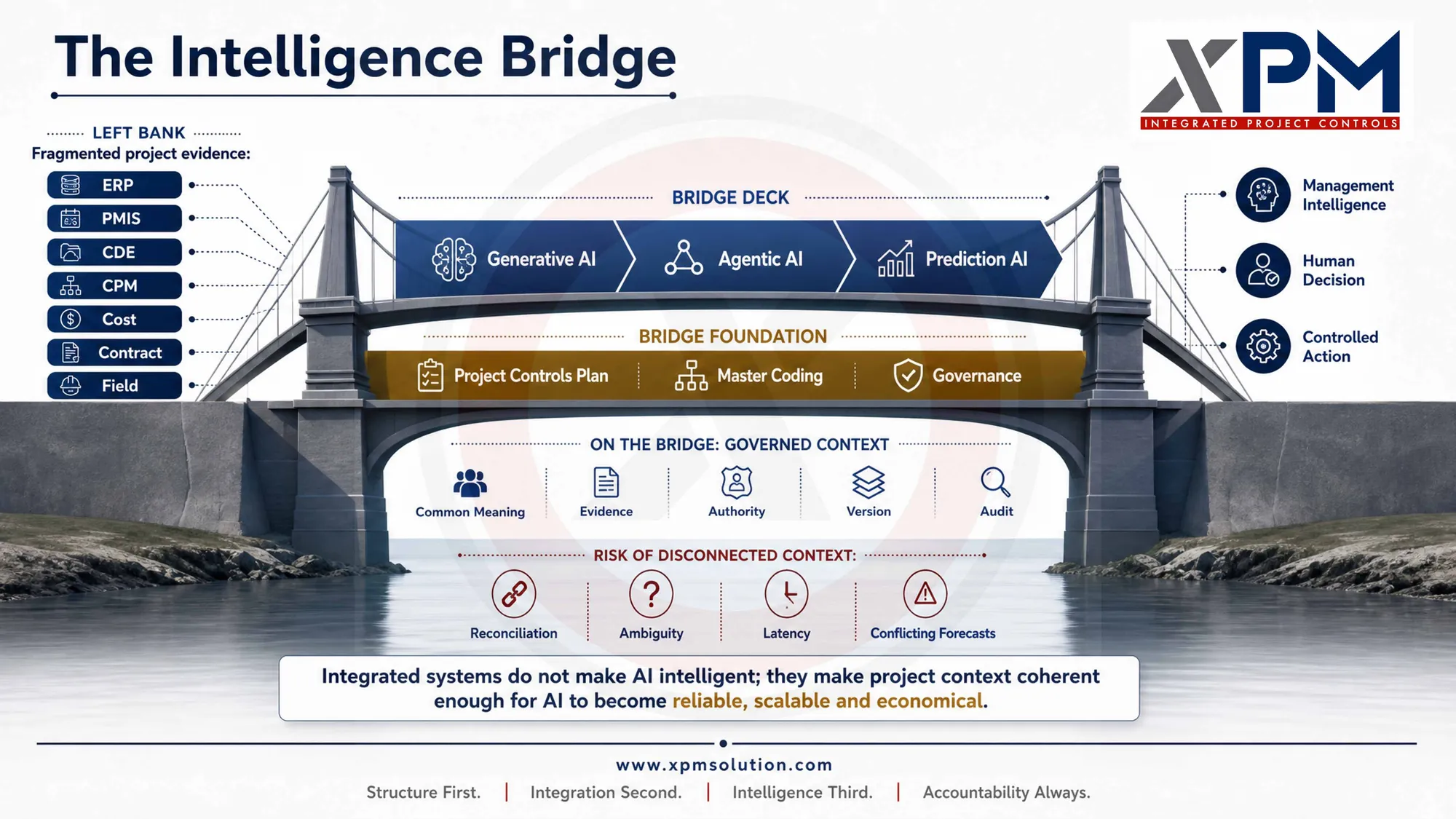
Once structure, evidence, and decision logic are established, AI earns its place, late in the architecture, not at the beginning.
Once structure, evidence architecture, and decision logic are established, AI earns its place. That is why we put it late in the architecture rather than at the beginning.
Generative AI can summarize controlled information, classify documents and events, compare alternatives, draft management narratives, and surface contradictions for review.
Agentic workflows can coordinate multi step work within defined permissions. As an xPM design pattern, we expect an agentic workflow to interpret intent, plan, retrieve governed information, use approved tools, check results, escalate exceptions, and confirm completion. That pattern is ours, and no vendor endorses it. Published engineering guidance points in a compatible direction. Anthropic advises that agents gain “ground truth” from the environment at each step, that they can pause for human feedback at checkpoints, and that they run with stopping conditions and guardrails, with simpler workflows preferred wherever those suffice.21 For governance, the anchor should be a governance class source such as the NIST AI Risk Management Framework,23 not a vendor engineering post. For consequential work, verification belongs inside the workflow rather than after the answer.
Predictive AI can support early warning, pattern recognition, forecast ranges, and sensitivity to key drivers. The objective is to make uncertainty more visible, not to convert it into false precision.
Smaller or locally deployed models may be appropriate where privacy, latency, cost, control, or domain specific behavior matter more than raw scale.
Human oversight is necessary but not automatically sufficient. NIST identifies automation bias and over reliance as risks of the human and AI configuration itself,13 and the Center for Security and Emerging Technology at Georgetown University cautions that “human-in-the-loop cannot prevent all accidents or errors.”22 Oversight works when the reviewer has the time, context, and authority to disagree.
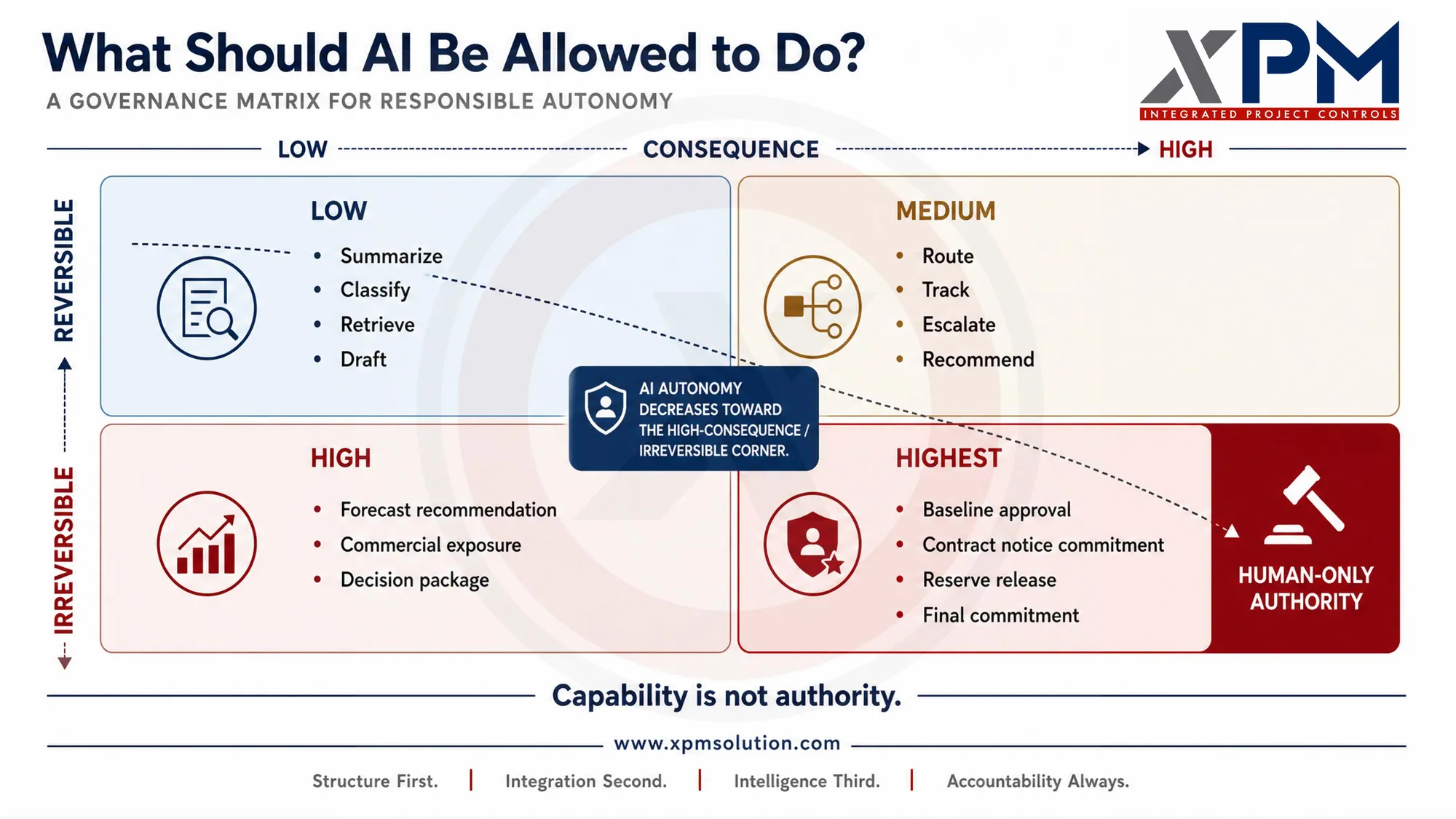
The tool should follow the decision problem. The decision problem should not be redesigned to justify the tool. And one boundary is non-negotiable: capability is not authority.
The boundary can be drawn as a matrix. This is an xPM editorial position rather than an industry standard: as consequence rises and reversibility falls, the autonomy granted to a system should fall with it, until the final commitment sits with a named person.
What This Argument Does Not Claim
A fair version of this argument needs its limits stated.
It does not claim that all decision quality work stays expensive.
AI also makes red teaming, sensitivity runs, pre-mortems, and evidence tracing cheaper, and organizations should use it for exactly that. What remains expensive is the commitment itself: the consequence, its reversibility, and the accountability for it.
It does not claim that governance is free.
Governance carries cost and latency. The same Strategic Investment Board review found that decision time can be “extended so that accountability can be diffused,” producing defensive decision making.8 Governance should be proportionate to consequence.
It does not claim that human judgment is unbiased.
Optimism bias and strategic misrepresentation are well documented human causes of cost overruns.9 The case for accountable human authority is not that people are always right. It is that someone must own the consequence and be able to explain the reasoning.
It does not claim that structure is the only constraint.
Flyvbjerg pairs better forecasting with better incentives, and treats incentives as the more important of the two, because a political problem cannot be solved by technical means.9 No evidence architecture fixes an incentive to underestimate. Where approval is rewarded more than performance, the decision case has to be tested by someone who does not benefit from the answer.
It does not claim that Structure First means waiting for perfect structure.
Most portfolios will never be fully structured. Start with the decisions that carry the most consequence, and structure those first.
The narrower, stronger claim. AI is making analysis cheap, and parts of decision support with it. It is not making commitment, consequence, or accountability cheap.
Three Lessons for Project Controls Leaders
Operational capability matters more than demonstration. Faster output can create decision debt. Measure business outcomes, not AI adoption.
Operational capability matters more than demonstration.
A compelling demo is easy to admire. A dependable management capability must survive real project data, permissions, workflows, exceptions, and operating pressure. A dashboard is not a decision. A forecast is not an action. A recommendation is not approval.
Faster output can create decision debt.
Software engineering has used the “technical debt” metaphor since Ward Cunningham introduced it in 1992. His point was that code shipped before the team fully understands the problem carries an obligation to be revisited as that understanding improves.24 We apply the same metaphor to decisions: undocumented assumptions, conflicting versions, unclear provenance, unexplained overrides, and recommendations whose rationale cannot later be reconstructed. We do not claim the term as original. Our contribution is its application to capital project decisions.
A related risk already has a name. Jonathan Zittrain describes “intellectual debt” as accepting answers that work without understanding why they work.25 An organization can possess the output without possessing the reasoning. Accountable management requires a qualified person who understands the logic well enough to question it when conditions change.
Measure business outcomes, not AI adoption.
Adoption is already broad. Scaling value is harder. In the 2026 McKinsey global survey, 44% of respondents report that AI is scaling across their enterprise, up from 38% a year earlier.26 The useful questions are practical. Did the decision cycle become shorter? Did an exposure become visible earlier? Did the Owner understand the risk being retained? Was a weak assumption challenged before commitment? Did the project learn from prior projects instead of repeating them? Those questions are closer to value than the number of models, agents, or dashboards in use.
The xPM Decision Bar for Consequential Projects
As analytical capability grows, the bar for a decision-ready case should rise with it, applied in proportion to consequence.
As analytical capability grows, the bar for a decision ready case should rise with it. This is an xPM editorial position rather than an industry standard, and it is meant to be applied in proportion to consequence. The full bar belongs on decisions that commit capital, change a contractual position, or alter risk allocation. Routine decisions need only the first four criteria. For a consequential capital project decision, we would expect the case to be:
- The xPM Decision Bar
- The xPM Decision Bar is a nine-criterion test — framed, evidence-backed, context-aware, assumption-visible, scenario-tested, consequence-conscious, challengeable, explainable, and accountable — that a consequential capital-project decision case should clear before commitment, applied in proportion to the consequence of the decision.
| No. | Criterion |
|---|---|
| 01 | FramedThe decision, alternatives, and success measures are explicit. |
| 02 | Evidence backedEach material claim is traceable to a governed source. |
| 03 | Context awareStandards and history inform the decision without overriding the live project. |
| 04 | Assumption visibleKey assumptions and unknowns are stated, not buried. |
| 05 | Scenario testedPlausible futures and sensitivities have been considered. |
| 06 | Consequence consciousThe reversibility and materiality of the decision are understood. |
| 07 | ChallengeableA reasonable person could interrogate the basis and follow the logic. |
| 08 | ExplainableThe reasoning can be reconstructed and defended after the fact. |
| 09 | AccountableA named human owner holds authority for the commitment. |
The practical test is simple. At your next gate review, ask which of these nine your current decision case would fail today, and fix that one first.
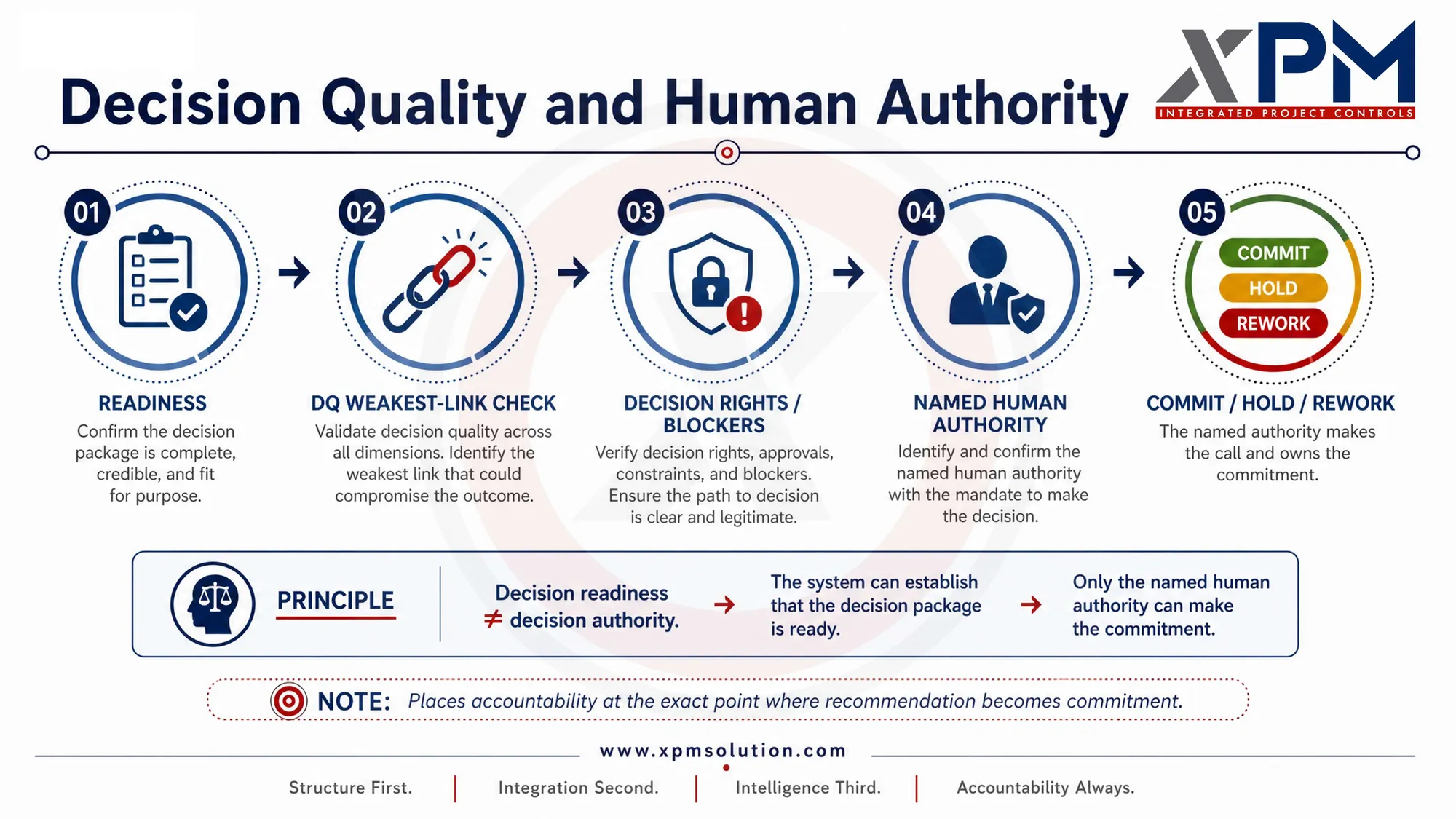
The last criterion needs one clarification. Boards, investment committees, and delegated authority matrices often decide collectively. That does not remove accountability. AACE International’s terminology states that accountability “cannot be delegated but it can be shared.”27 In the xPM approach, shared or collective authority should still have a named decision owner who carries the decision, its conditions, and its follow through. Depending on the governance structure, that may be the sponsor, chair, or delegated executive. A related profession specific example appears in the global RICS standard on responsible AI use, in effect since March 2026, under which the surveyor “remains accountable for every piece of professional advice, regardless of the tools used to produce it.”28
The consequence belongs to the organization, not to the model.
xPM Point of View
Structure First. Integration Second. Intelligence Third. Accountability Always.
Our experience has led us to a simple sequence. We offer it as professional judgment rather than as a validated finding, and we say below what evidence would test it.
- Structure First
- Structure First is the opening step of the xPM sequence, which requires the management architecture — scope structure, coding, baselines, evidence roles, decision questions, governance, thresholds, and decision rights — to be defined before analytics or AI are asked to operate inside it.
Structure First
Define the management architecture before asking intelligence to operate inside it: scope structure, coding, baselines, evidence roles, decision questions and techniques, governance, thresholds, and decision rights.
Integration Second
Preserve project meaning across systems, processes, disciplines, and stakeholders. Connected data is useful. Integrated meaning is what makes the data decision ready.
Intelligence Third
Apply AI, analytics, forecasting, automation, and agents once the operating context is sufficiently governed. Intelligence should amplify the architecture, not compensate for its absence.
Accountability Always
A consequential decision should remain attributable to a named person accountable for carrying it within the applicable delegated or collective authority. That is not a limitation of AI. It is a requirement of management.
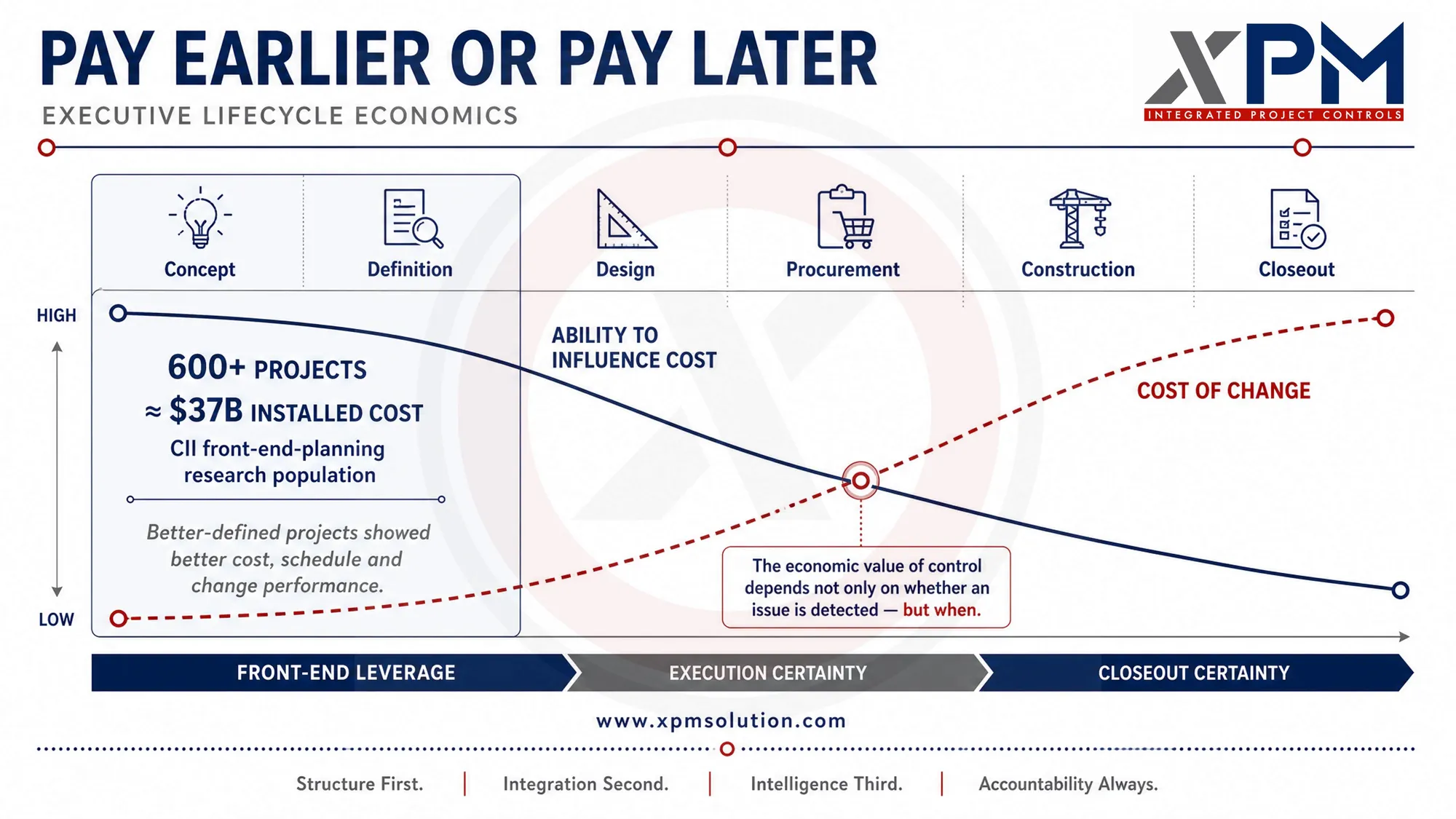
The closest research support we can point to concerns the front end. A National Academies assessment of federal project management records that data from the Construction Industry Institute show a positive correlation between front end planning and project performance in cost, schedule, change orders, and operational performance.29 That correlation draws on a Construction Industry Institute research population of more than 600 capital projects representing approximately $37 billion in installed cost.30 That supports structuring decisions early. It does not yet test our full sequence. An honest test would compare decision outcomes across portfolios that govern structure and evidence before deploying AI against portfolios that do the reverse, holding consequence and contract type constant. We would publish that result either way.
The future of Project Controls is not human judgment versus artificial intelligence. It is better human judgment supported by more disciplined intelligence.
The cost of producing an answer is falling. The cost of acting on the wrong one is not.
The xPM Sequence
Structure First.
Integration Second.
Intelligence Third.
Accountability Always.
Authorship and method
This article states the institutional point of view of xPM. The named author and voice are confirmed before publication, and that named person carries responsibility for the article. Draft preparation used AI assistance for research, source retrieval, and editing. Before publication, every source listed below is checked against the cited document by a qualified reviewer, and the professional judgments in the article remain our own.
Sources / References
Every source below is checked against the cited document by a qualified reviewer before publication.
- 1
- 2
- 3
- 4
- 5Dell’Acqua, F., McFowland III, E., Mollick, E., Lifshitz-Assaf, H., Kellogg, K. C., Rajendran, S., Krayer, L., Candelon, F., and Lakhani, K. R. (2023). Navigating the Jagged Technological Frontier: Field Experimental Evidence of the Effects of AI on Knowledge Worker Productivity and Quality. Harvard Business School Working Paper 24-013. Experiments were run in 2023 with GPT-4.View sourcePreregistered field experiment, working paperBack to citation
- 6
- 7
- 8Hannam, B. (2024). The Root Causes of Delay and Cost Overruns in Major Capital Projects. Strategic Investment Board, Northern Ireland, February 2024, page 22. The passage cited reports an ongoing review and the observations of officials involved in the process.View sourcePublic sector agency analysisBack to citation
- 9
- 10
- 11
- 12Regona, M., Yigitcanlar, T., Xia, B., and Li, R. Y. M. (2022). Opportunities and Adoption Challenges of AI in the Construction Industry: A PRISMA Review. Journal of Open Innovation: Technology, Market, and Complexity, 8(1), 45. Covers literature published before the generative AI wave.View sourcePeer reviewed systematic reviewBack to citation
- 13
- 14
- 15
- 16
- 17International Organization for Standardization (2018). ISO 19650-1:2018, Organization and digitization of information about buildings and civil engineering works, including BIM. Information management using BIM. Part 1: Concepts and principles, clause 12.1. A second edition is under development. The clause text is not readable on the catalog page, so the article paraphrases it rather than quoting it.View sourceInternational standardBack to citation
- 18Central Intelligence Agency, Center for the Study of Intelligence (2009). A Tradecraft Primer: Structured Analytic Techniques for Improving Intelligence Analysis. March 2009. The primer presents these techniques as aids to analysis rather than a comprehensive method.View sourceGovernment methodological guideBack to citation
- 19
- 20
- 21Anthropic (2024). Building Effective Agents. Anthropic engineering guidance.View sourceVendor engineering guidanceBack to citation
- 22
- 23National Institute of Standards and Technology. AI Risk Management Framework.View sourceU.S. government framework, voluntaryBack to citation
- 24
- 25
- 26
- 27
- 28
- 29
- 30Construction Industry Institute (2006). Front End Planning research and the Project Definition Rating Index (PDRI). University of Texas at Austin. Research population of more than 600 capital projects representing approximately $37 billion in installed cost.View sourceIndustry research programBack to citation
The series
This series
This article is the foundation of a thirteen-part series. Each article takes one section and works it through in depth — the detailed questions, the method, and what it looks like on a live project. New articles publish twice a month and are linked here as they go live.
- Intelligence Is Becoming Abundant. Judgment Is Not.Why raw analytical horsepower is now cheap while sound judgment stays scarce — and what that inversion changes.
- AI Changed the Economics of Production — Not the Responsibility of DecisionAI collapsed the cost of producing analysis, but accountability for the decision still sits with people.
- In Capital Projects, Cheap Analysis Does Not Equal Good DecisionsA low price per analysis says nothing about whether the resulting capital decision is any good.
- The New Executive Advantage Is Not More Answers. It Is Better Framing.Leaders win less by having more answers and more by framing the right question in the first place.
- Q1–Q5: The Five Management Questions That Turn Analysis into Decision SupportThe five management questions that convert raw analysis into genuine decision support.
- D1–D5: Not All Evidence Has the Same JobThe five evidence roles, and why each piece of evidence has a distinct job to do.
- From Questions to Evidence to Decision: How the SD Engine ThinksHow the structured-decision engine moves from questions to evidence to an accountable decision.
- Why Technique Depth MattersWhy the depth of the underlying technique — not surface output — determines whether analysis can be trusted.
- What AI Should Actually Do in This SystemDefining the specific, bounded role AI should play inside a structured decision system.
- Lessons from the New AI Economy for Project Controls LeadersWhat project controls leaders should take from the economics of the new AI landscape.
- The Decision Standard for Consequential ProjectsThe standard a decision must meet before it is used to commit consequential capital.
- The Final Shift: From More Intelligence to Accountable DecisionMoving the goal from producing more intelligence to owning an accountable decision.
- xPM Point of View: Structure First. Integration Second. Intelligence Third. Accountability Always.The xPM position: structure first, integration second, intelligence third, accountability always.