










“What must be in place for AI to improve project decisions?”
One Management Truth is a shared, governed basis for decisions: the team knows which evidence governs, what remains uncertain and who can act. AI can help when that basis is connected to a workable review process and people with the authority and capacity to respond. This series turns that requirement into three implementation questions and practical workflows.
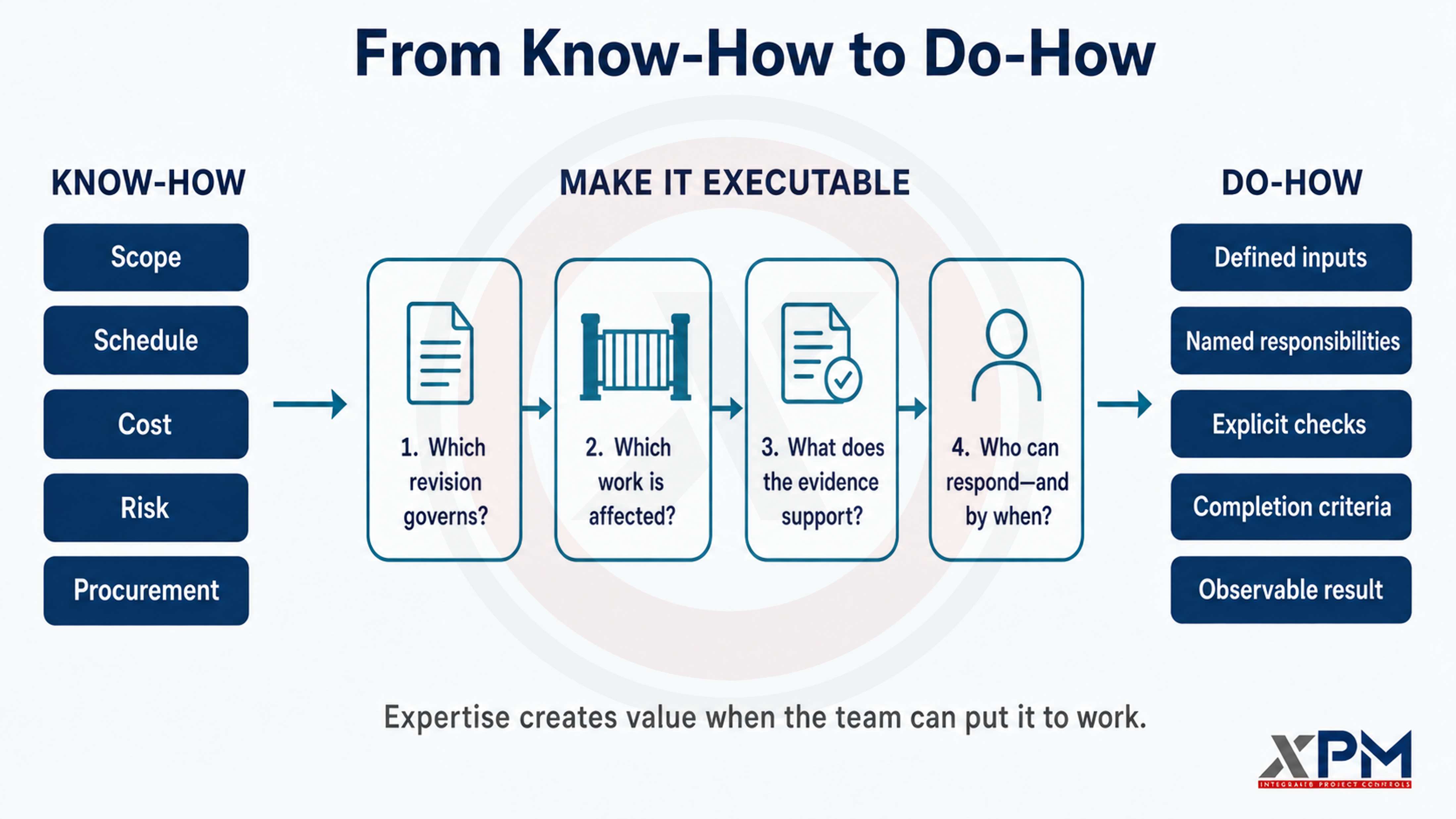
Consider a familiar project situation. A design revision arrives. AI summarizes the change in seconds. The summary is clear. The document is correctly identified.
Then the questions begin.
Which work package does it affect? Has procurement already committed? Does the schedule reflect the latest approved scope? Who needs to decide, and how much time remains before the options narrow?
This is an illustrative situation, but the management problem will be familiar to many project teams. Faster reading helps. Turning what has been read into an accountable response requires considerably more.
Our “Prediction AI in Project Controls” presentation materials frame the question behind this work:
Are we improving how projects are managed—or adding intelligence to processes that still cannot carry a decision through?
The distance between knowing and doing
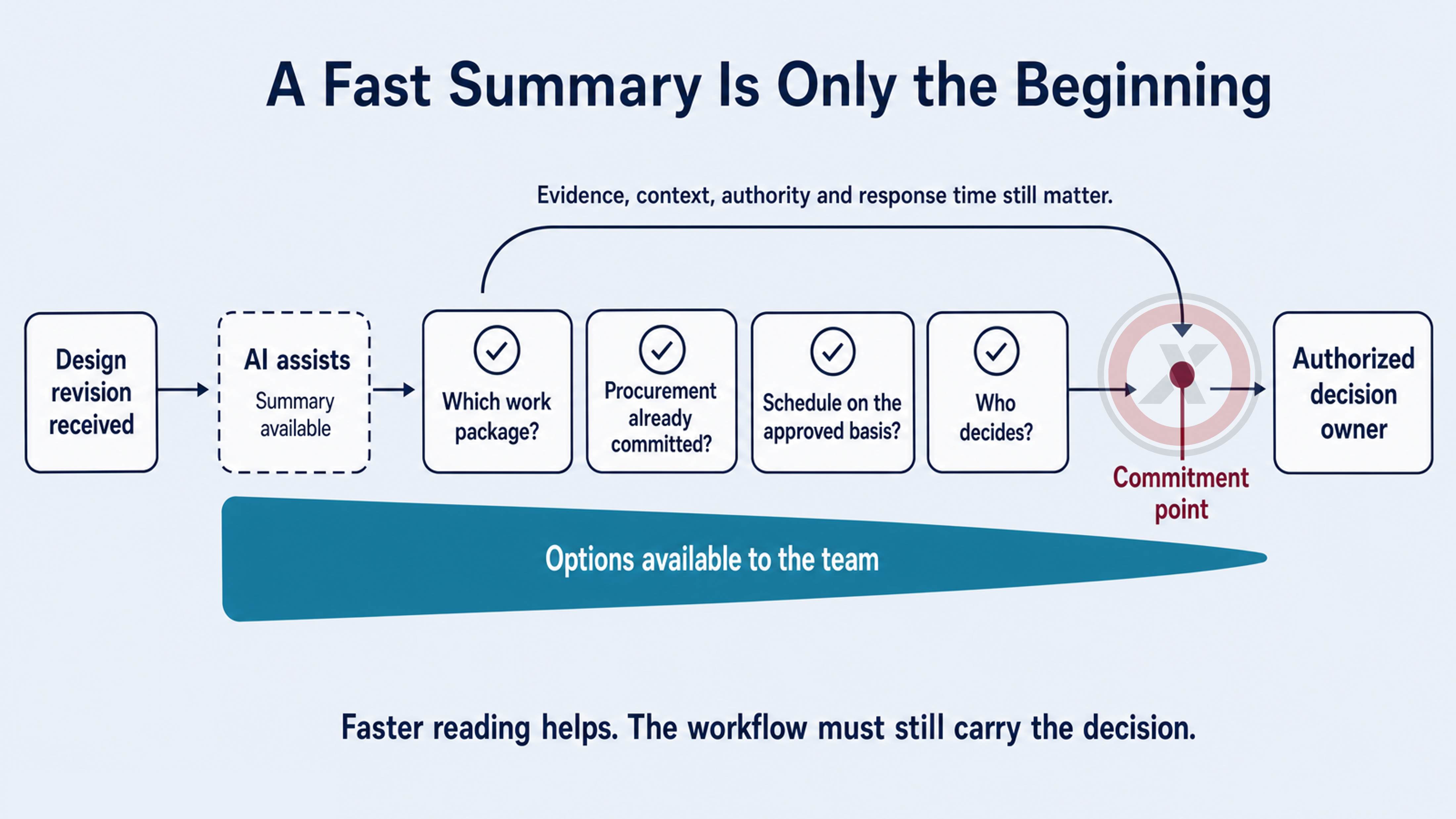
Project management has a substantial body of knowledge. Across scope, schedule, cost, risk, procurement and the other knowledge areas, practitioners can draw on books, standards, training and decades of experience. AI makes explanations, examples and first drafts even more accessible.
That access is useful. Yet knowing that a change should be assessed does not establish how this team will assess this change, using these records, before this commitment becomes irreversible.
Someone must identify the governing revision. Someone must connect it to the affected work. Someone must distinguish an initial concern from a supported impact assessment. Someone must have the authority and time to respond.
Know-how includes practical expertise. By do-how, I mean making that expertise executable in a specific project: defined inputs, responsibilities, checks, completion criteria and an observable result.
One management truth means a shared, governed basis for decisions—with source versions, assumptions and unresolved differences visible. It does not require everyone to agree, or every record to sit in one software platform. It requires the team to know which basis governs which decision and what remains open.
For owners and executives, more analysis can coexist with the same unresolved decisions. The practical test is whether the team can use the information while useful choices remain. Value should be assessed through total review and correction effort, time to an accepted decision, and options preserved before commitment—not simply the speed of AI output. Before a pilot begins, agree on who supplies the review capacity and what evidence would justify expansion, revision or a stop.
The work behind the question
xPM is a technology-enabled, senior-led Project Controls and decision-support consultancy. Our work focuses on the handoffs between project information, technical assessment and management action: which evidence governs, how it connects to affected work, who can act and what confirms completion.
These questions guide our AI implementation design and the Project Control Index, the working name for our developing assessment approach, not a validated benchmark or released product. Our delivery experience informs the design but does not replace testing its effectiveness.
The contribution we aim to make is practical: connect established controls to explicit evidence checks, review responsibilities, AI permissions and closure records within the team's existing systems. Do-how describes that execution discipline. It does not claim to replace integrated change control, earned value management or baseline review.
The recurring question is straightforward: what must be in place for a project to use intelligence effectively?
Our proposed assessment workflow connects criteria to project evidence, brings individual judgments into a facilitated review, records agreed findings and routes them to action, risk review or strategic decision support. Named people make the approvals. AI helps suggest evidence and organize the work; it does not own the finding or the decision.
The proposed design draws on the U.S. Government Accountability Office's best-practice guides—Cost Estimating and Assessment Guide, GAO-20-195G (2020) (opens in a new tab) and Schedule Assessment Guide, GAO-16-89G (2015) (opens in a new tab)—alongside Integrated Baseline Review (IBR) guidance listed by DOE (opens in a new tab) and xPM's own readiness questions. These are distinct inputs, not one combined standard or certification. Each assessment retains its source, criteria and result. We distinguish process completeness, control integrity and observed outcomes: completing a review does not prove that a control works, and a strong assessment does not by itself demonstrate better project performance. Something not measured remains “not measured.”
This is a developing design with illustrative runs. Project experience informs it; operational effectiveness still needs to be tested.
Three dilemmas worth examining
Three connected dilemmas help test the design against the realities of implementation. Each asks a different question about implementation; none establishes a universal rule that only two of three goals can coexist.
01 — The AI Adoption Dilemma
How do we start learning without deploying beyond our readiness?
Technology changes, but concerns about work, trust, value and accountability return. People need to know how their responsibilities will change, which information they can trust, whether the benefit survives the cost of review, and who answers when something goes wrong.
Under a short deadline and fixed capacity, launching widely can outpace preparation. A bounded application creates a more manageable path: verify the conditions for one task, measure accepted results and total effort, then decide whether to expand.
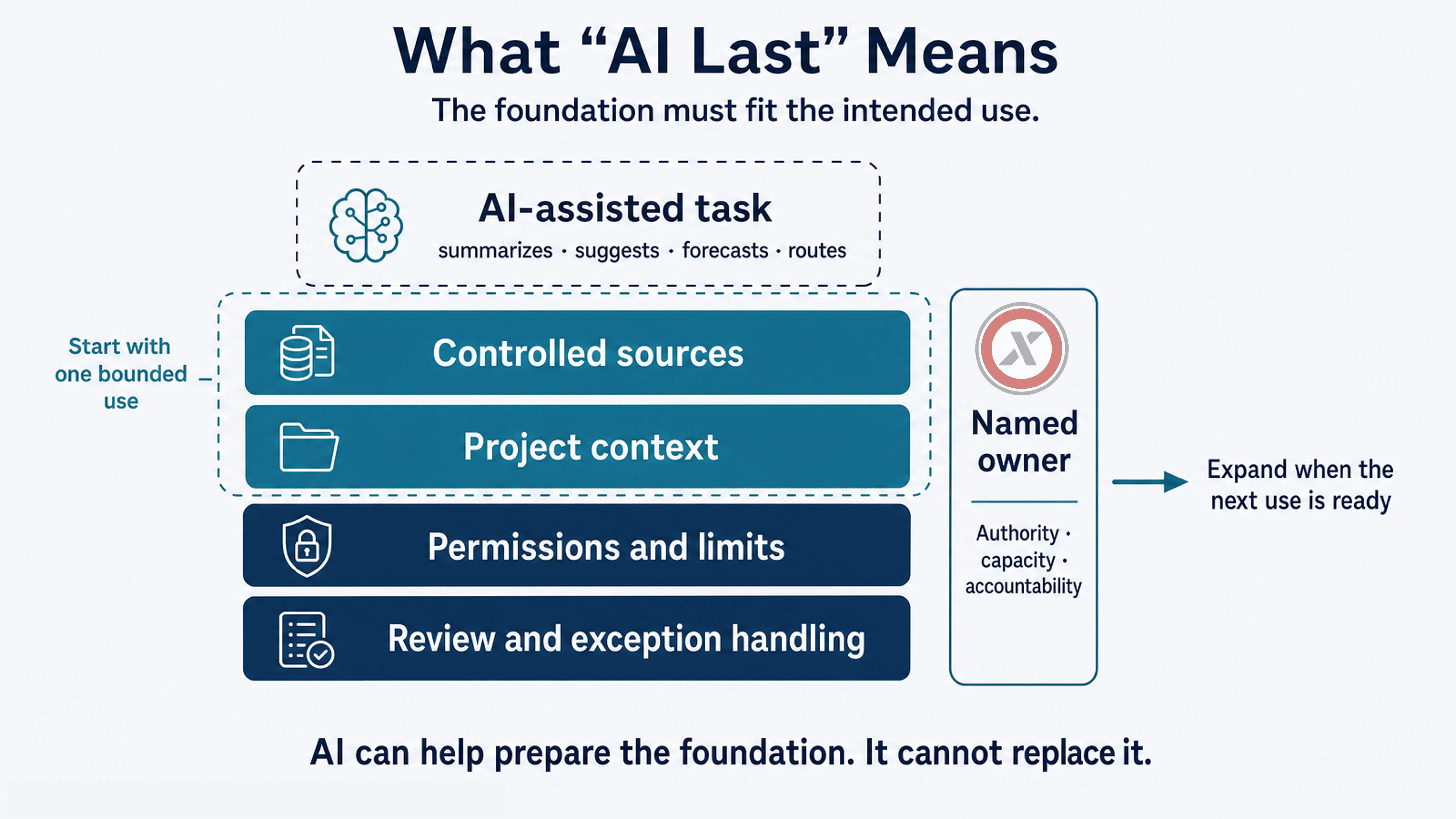
Explore the four scenarios and the practical pilot agreement:
02 — The Early Intelligence Dilemma
When is a signal strong enough to investigate—and strong enough to support commitment?
In the design-revision example, an early message can justify checking procurement exposure. It does not establish approved scope, a quantified delay or permission to instruct work.
Source authority, version and context determine whether information is eligible for its intended evidentiary use. Admission alone does not prove accuracy or impact. A reviewed forecast still needs suitable methods, relevant backtesting and calibration, and explicit uncertainty.
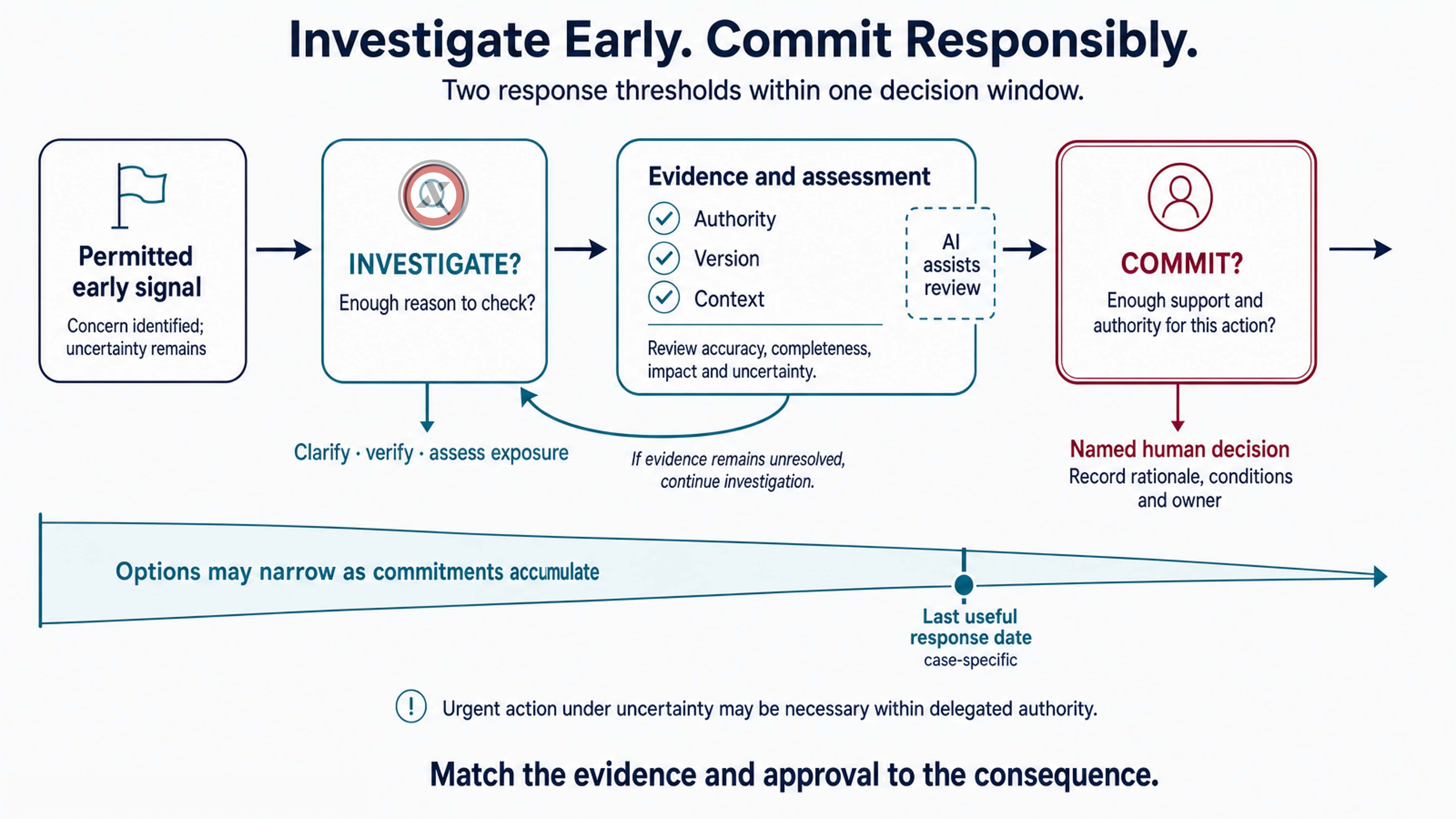
Explore the detection trade-offs and the two response thresholds:
03 — The Maturity Dilemma
Can the organization use the capability it has built?
A capable system can produce useful recommendations while its reviewers lack time, decision owners lack authority, or the working culture discourages unwelcome information. More technical capability can then produce more activity without a better response.
Reading the ASU-led IP2M METRR research, whose team includes Professor David Grau (opens in a new tab), prompted an important shift in my perspective. Its separate attention to system maturity and the operating environment sharpened a question for our own work: are we examining the system closely while taking its operating conditions for granted?
DOE's IP2M METRR training overview (opens in a new tab) provides background on that research context. Integrated Project/Program Management Maturity and Environment Total Risk Rating (IP2M METRR) is a research-based assessment approach for earned value management system (EVMS) maturity and environment. It does not directly validate an AI implementation model. It provides a research lens that we intend to explore more deeply in our AI implementation and Project Control Index work, alongside other established frameworks.
Explore the evidence scenarios and the practical assessment checks:
Making do-how visible
These dilemmas lead to a practical commitment: show how the work can be done.
Our publication plan includes dozens of workflows and illustrations from our Integrated Project Controls work. This is a planned series, to be released in stages as individual lessons are completed. The series will cover control architecture, shared project identity, multidimensional control, governed AI, evidence and decision workflows, the economics of control, and strategic decision support.
Each lesson will begin with a management question, show a concrete workflow or relationship, explain its limits and end with a check readers can apply to their own projects.
Explore the topic map and the approach behind the forthcoming series:
Start with one decision
The most useful next step is to examine one decision in your own project.
Start with one decision that is harder than it should be.
It may involve a design change, a procurement commitment or an emerging schedule risk. If the information exists but the path to action remains unclear, that is a practical starting point for a conversation with xPM.
We can discuss how the workflow operates today, where the handoffs break down and whether our work could help. A short description of the decision and where it stalls is enough to frame that initial conversation.
Better technology does not automatically create better decisions. We have to build the way of working that connects them.
Practical knowledge. Visible execution. Accountable decisions.
Structure First. Integration Second. Intelligence Third. Accountability Always.
AI can inform the decision. It does not own it.
Omer Bisen, PhD
xPM Solution
Research reference
For background on IP2M METRR and its research context: U.S. Department of Energy — IP2M METRR training and performance implications (opens in a new tab).
- Arizona State University — IP2M METRR research team (Professor David Grau, School of Sustainable Engineering and the Built Environment) (opens in a new tab)
- U.S. Department of Energy, Office of Project Management — IP2M METRR (ASU EVMS Study) and research reports (opens in a new tab)
- U.S. GAO — Cost Estimating and Assessment Guide, GAO-20-195G (March 2020) (opens in a new tab)
- U.S. GAO — Schedule Assessment Guide, GAO-16-89G (December 2015) (opens in a new tab)
- U.S. Department of Energy — EVMS implementation guidance, including the NDIA Integrated Baseline Review Guide (opens in a new tab)